
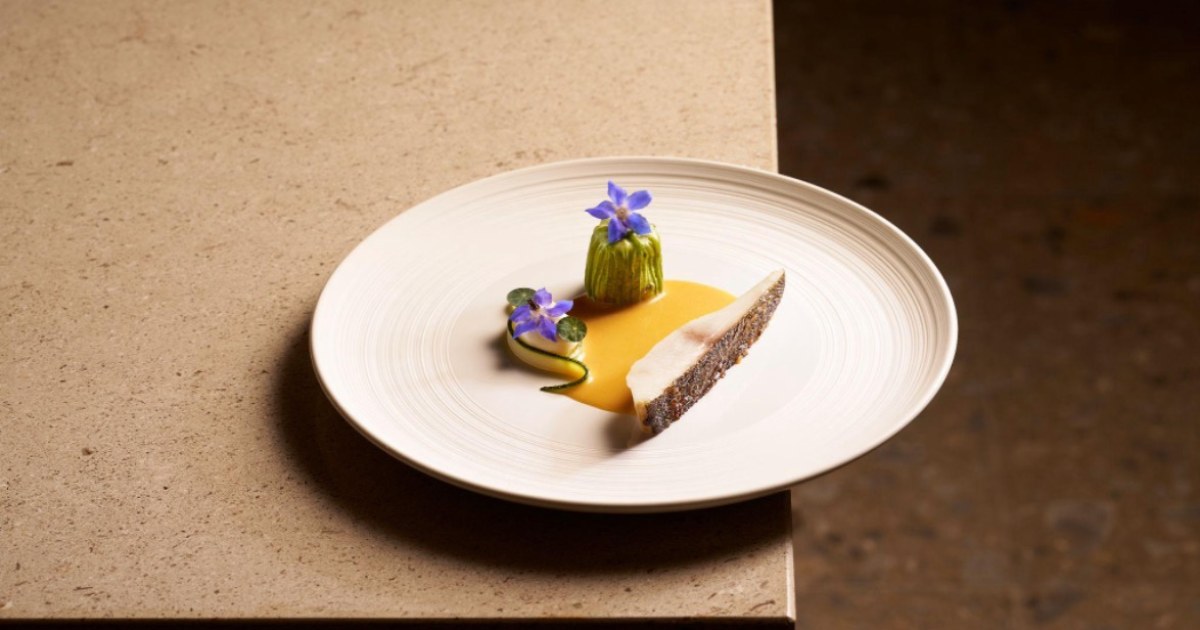
Beurre blanc has its roots in the Loire Valley of France, yet it has a place on Loca Niru’s menu alongside samegarei, a Japanese roughscale flounder. The pairing reflects an approach to cooking in which French technique is chosen to bring out the character of an ingredient, rather than to impose a particular culinary style on it.
For Chef Shusuke Kubota, French sauce-making offers a way to build texture, acidity and depth around Japanese seafood. The aim is not to make the fish taste French or to replace Japanese preparations, but to find the technique that best serves the ingredient in front of him.
What a Butter Emulsion Brings for White Fish
A beurre blanc begins with a reduction, typically made with white wine, vinegar and shallots, into which butter is gradually incorporated to form a smooth emulsion. The result is a sauce with richness, a silky texture and a bright acidity that helps keep the butter from feeling heavy.
Paired with white fish, these qualities can provide contrast without overwhelming the seafood. The butter gives the sauce body, while the acidity helps balance its richness and brings definition to the overall flavour.
This is one point at which French and Japanese culinary approaches can meet. Japanese cooking often uses citrus, vinegar and other acidic ingredients to sharpen flavours and create balance. A beurre blanc approaches that same consideration through a different combination of ingredients and techniques.
The choice of sauce depends on the fish, its preparation and the character of the finished dish. At Loca Niru, the intention is to make those elements work together, allowing the seafood to remain central while the sauce adds another dimension.
The Precision Behind the Sauce
An emulsion is only as good as its execution. With beurre blanc, temperature and timing are particularly important because excessive heat can cause the butter to separate from the liquid, leaving an oily rather than cohesive sauce.
The butter must be incorporated carefully, and the finished sauce needs to remain warm enough to retain its fluid texture without becoming so hot that the emulsion breaks. Too much cooling can also affect its consistency.
These details matter during service, particularly in a fine dining Japanese restaurant where each course is plated to order. A sauce that has been prepared correctly but held poorly can lose the texture that makes it effective alongside the fish. The timing of the final preparation and plating therefore contributes as much to the experience as the ingredients themselves.
The objective is a sauce that coats the seafood lightly, with enough body to carry its flavours and enough acidity to keep the overall dish balanced.
A Training Shaped by Two Culinary Traditions
Chef Shusuke Kubota’s experience spans Japanese culinary training, French kitchens and contemporary restaurants in Tokyo. That background informs Loca Niru’s approach to bringing different techniques together without losing sight of the ingredient.
The menu offers several examples of this thinking. A green tiger prawn is served with garlic sabayon, where the sauce contributes a rich, delicate texture. Samegarei is paired with a beurre blanc informed by Nyonya flavours, bringing regional aromatics into a French preparation. Elsewhere, a reduced beef jus adds depth to a combination of beef and pumpkin, while a pineapple glaze introduces a different balance of sweetness and acidity.
These are not simply classical sauces placed beside Japanese ingredients. Each preparation is adapted to the dish, with the sauce, seasoning and supporting ingredients chosen to create a coherent result.
The same principle applies whether the starting point is a French emulsion or a Japanese ingredient: technique matters because of what it allows the kitchen to achieve.
Knowing When a Sauce Is Not Needed
Not every course calls for a sauce. Loca Niru’s tasting menu also includes preparations that rely on pickling, curing, the character of the produce or the seasoning of the dish itself.
The iron-pot rice served towards the end of dinner, for example, takes a different direction, with vegetables and sansho pepper providing its character.
Richer preparations are balanced by lighter ones, and the experience does not depend on every dish using the same technique.
This restraint is part of the broader philosophy explored in our Ode to Japanese-French Cuisine. The objective is not to demonstrate every technique the kitchen can use, but to choose the approach that makes sense for each course.
Portioning matters, too. A sauce should contribute to the seafood rather than overwhelm it, and its quantity needs to reflect the intensity of the other elements on the plate. The measure of a successful pairing is how the dish comes together, not how much sauce it contains.
Tasting the Method
The sauces featured on Loca Niru’s menu change with the season and the ingredients available. A beurre blanc, sabayon or jus may play a different role from one menu to the next, but the guiding consideration remains the same: choosing the technique that allows each ingredient to express its character.
Discover how Japanese ingredients and French technique come together at Loca Niru. Experience our tasting menu at the House of Tan Yeok Nee.