
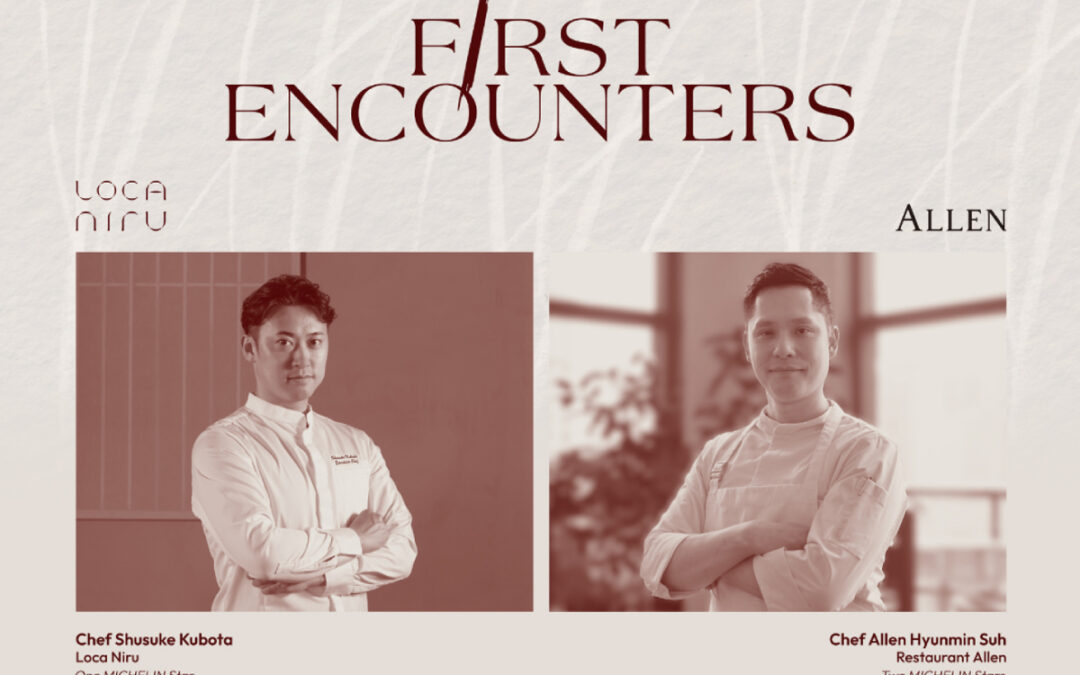
First Encounters, our first anniversary four-hands collaboration, brings Chef Allen Hyunmin Suh of Restaurant Allen in Seoul — a two MICHELIN Star kitchen — into Loca Niru on 27 and 28 October.
Chef Allen’s path to his own restaurant ran through some of the kitchens that shaped how tasting menus are built today. He trained under Daniel Humm at Eleven Madison Park in New York before returning to Korea to open L’Impression, a French restaurant that earned Michelin recognition in its first year. Restaurant Allen, opened in 2021, is his more personal project — a kitchen built around Korean terroir read through French technique, where the sourcing of each ingredient is treated as part of the story the menu tells. It picked up a Michelin star in its own first year and a second the year after, the same trajectory Loca Niru has just completed.
It sits within a wider programme of anniversary events running through to December, with the autumn menu continuing alongside it until 16 December. The menu and pricing for First Encounters are being finalised and will be announced closer to the date. Guests who want to be notified as soon as details are confirmed can register their interest with our team.
What a Four-Hands Dinner Actually Takes
Two chefs cooking one menu sounds like a straightforward arrangement. The difficulty is that a tasting sequence is an argument with a beginning and an end, and two kitchens rarely start from the same premise.
Collaborations of this kind have become common across Japanese fine dining in Singapore, and the good ones are distinguishable from the rest by how much genuine negotiation went into the running order.
Agreeing the Shape Before the Dishes
The first conversation is about structure, not recipes. How many courses, where the weight falls, which chef opens and which closes, and whether the meal is built to alternate or to hand over cleanly at a midpoint. Get that wrong and the dinner reads as two menus served consecutively. Most collaborations settle this in a single long conversation, and the ones that leave it vague pay for it on the night.
Producers have to be settled early as well. A visiting chef cannot bring a full larder, so the host kitchen sources against someone else’s standards, and that is often where the real work sits. Substituting an ingredient a visiting chef has built a dish around changes the dish, and both sides have to agree what is acceptable before service.
What Each Kitchen Gives Up
Both sides lose control of the pacing they would normally set alone. A chef who usually builds towards a single main course may find it landing third, and the discipline is in accepting that rather than defending a habit. The dinners that fail are the ones where neither chef conceded anything. Service itself is the other concession, since two brigades who have never worked together are sharing one pass, and the timing has to be rehearsed rather than assumed.
Why the Format Is Worth the Trouble
Working beside another kitchen exposes assumptions that are invisible in a familiar service. A technique that has gone unquestioned for years gets asked about directly, and how thoughtful craft shapes a plate turns out to be easier to explain to a guest than to a peer.
Chef Shusuke Kubota takes the same view of collaboration that he takes of regional produce, which is that something has to change as a result. A dinner that leaves both kitchens exactly as they were has not earned the format. Techniques picked up in two days of shared service tend to surface on the regular menu months later.
Following the Programme
Guests who want to be notified as soon as details are confirmed can register their interest with our team.
Reserve a table at Loca Niru or ask our team what is running when you plan to visit.