
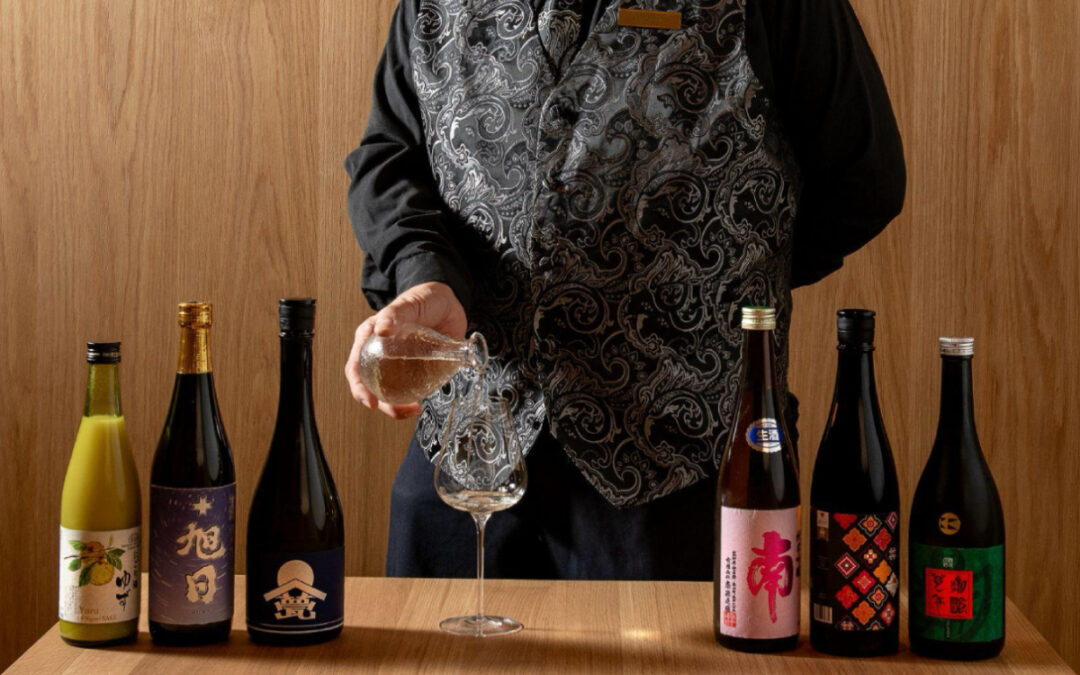
Autumn is the hardest season to pair well. The food gains weight and smoke, acidity arrives from fermentation instead of citrus alone, and sweetness at the end of the meal turns darker than it does in summer.
A pairing across a Japanese seasonal menu has to move with all of that. The courses are fixed, so each pour answers a specific problem, not a general style. That constraint makes the work more precise, not less interesting.
Reading the Course First
The starting question is what the dish is already supplying. Our returning bonito is smoked over rice straw and served with fermented green tomato and blue cheese cream, which means the glass does not need to add either richness or acidity. Château Pibarnon takes that course on the wine side because Bandol rosé carries savoury grip and salinity without contributing fruit weight, and the sake flight answers it with Shinomine’s Omachi Yamahai, where the fermentation-driven acidity meets the green tomato on its own terms. Adding weight to a course that already has it is the most common error of the season.
Both flights open lighter than they finish. Champagne Pommery Apanage 1874 sets the wine sequence with dryness and lift, while Kirei Shuzo’s Mannen Junmai Daiginjo Nama Genshu opens the sake flight with the same intent, unpasteurised and undiluted but still clean enough to leave the palate open.
Sake and wine solve different problems in the same sequence, which is why our sommelier reads the whole progression before deciding any single pour. A flight that peaks too early leaves nothing for the main course.
Where Autumn Gets Difficult
Truffle and mushroom broth flatten many pairings, and a pour that works beside grilled fish can disappear entirely against Gan Modoki, a rich consommé made from autumn truffle and mushrooms. Domaine Valentin Zusslin’s Bollenberg Gewurztraminer holds its ground there through aromatic intensity rather than sugar, and Daishinshu’s Chokarakuchi does the opposite job, cutting straight through the broth with a bone-dry finish. Where the plate turns to butter and grilled fish, Zenato’s Lugana Riserva has the texture to sit under the sauce, and Toyokuni’s Ibuki Matou Edition brings a rounder, more savoury profile for guests taking the sake sequence.
The wagyu course brings its own complication, since a pineapple glaze introduces sweetness to a savoury plate and a tannic red will fight it. Chapoutier’s Barbe Rac answers with the ripeness and low grip of old-vine Grenache, which meets the glaze instead of arguing with it, while the kimoto structure of Juji Asahi’s Enishi no Mai gives the sake flight enough acidity to hold against both the fat and the sugar. Iron pot rice after it resets the palate, which gives the following pour an easier job than it would otherwise have.
Finishing the Meal
Desserts built on gula melaka and chestnut need a pour with enough depth to meet palm sugar without turning cloying. That is a narrower target than it sounds, and it is usually solved by texture instead of sweetness. Quinta do Noval’s 2003 Colheita has the dried fruit and nutty oxidation to carry the chestnut where a lighter fortified wine would vanish, and Kirei Shuzo’s Hachi-ku closes the sake flight with the density that five-stage brewing produces, rich enough for palm sugar without being sweet itself.
The same reasoning shaped the pairings written for our 8-Course Summer Tasting Menu, though the season has moved the answers a long way since then. Summer rewarded lift and acidity, while autumn asks for depth held in check.
What Runs This Quarter
Both flights run at six pours alongside the autumn menu through to 16 December, and guests who prefer individual pours are never obliged to take the full sequence.
Two additional pairing programmes sit inside our anniversary quarter, a two-day pairing dinner and a month-long pairing running from the middle of November, both built with the producer appearing alongside our October collaboration. Both sit alongside the autumn menu without replacing it, and details are confirmed closer to each date.
Tasting the Season
A flight is easier to judge in a glass than on paper, and our team can talk through the current sequence before you commit to it.
Reserve a table at Loca Niru and ask about the autumn pairing when you book.