
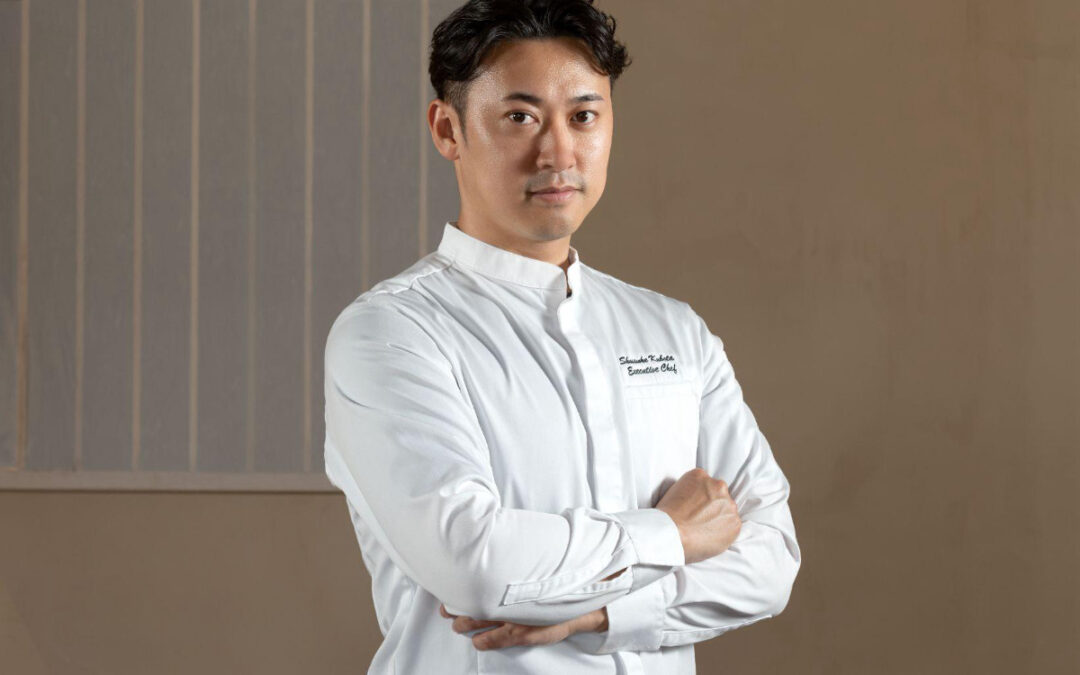
Living in Singapore changed how Chef Shusuke Kubota sees food. Japanese ingredients and technique remain central to his cooking, but being surrounded by Singapore’s many food cultures made him increasingly curious about Southeast Asian herbs, spices and produce. That curiosity now runs through the Japanese-French cuisine at Loca Niru.
“I am not trying to recreate Southeast Asian dishes,” Chef Shu says. “I want to understand the ingredients and their cultural background, then find where they naturally meet my own Japanese roots.”
A Third Vocabulary, Not a Garnish
Regional produce works best when it contributes more than decoration. A single tropical fruit dropped onto a classical plate reads as decoration, and diners who know both traditions notice immediately. The test Chef Shu applies is whether an ingredient changes how a dish works, not how it looks. At Loca Niru, novelty alone is never the reason for its inclusion.
How the Kitchen Learns an Ingredient
Before a local ingredient enters a trial, Chef Shu researches its cultural background and how it is traditionally used. That process of understanding an ingredient before cooking with it sits close to how shared kitchens spark new ideas, where technique travels between cooks faster than it travels through books. Local produce then reaches the plate with its own logic intact, rather than borrowing a flavour while discarding the reason for it.
Where the Traditions Meet
French technique supplies structure. Japanese practice supplies restraint and a calendar. Southeast Asia supplies acidity and aromatics that neither reaches for in quite the same way. Together, they shape the dish from different directions, each contributing something the others do not.
The Isaki course is where this comes together most clearly, and it has a history behind it. The dish began as Chef Shu’s entry in a cooking competition, built around Singapore as a theme using Japanese ingredients and technique, and it has kept evolving since. Today the kitchen uses a large Isaki from Oseto Suisan in Wakayama, a producer Chef Shu has worked with and supported for years, raised through sustainable aquaculture and never under one kilogram. The fish is cooked until the skin is beautifully crisp, then served with a classic French beurre blanc carrying Nyonya rempah, a flavour with deep roots in Singapore’s Peranakan culture.
“Japan, France and Singapore, together on one plate,” Chef Shu says. “Bringing different cultures into one dish is very close to what we want to express at Loca Niru.”
What This Asks of a Diner
Guests familiar with Japanese and French fine dining will recognise most of what is in front of them. The unfamiliar element is usually the regional one, and our team will name it and explain its role if asked. Nothing on the menu requires a glossary, though the kitchen is glad to provide one. Curiosity is rewarded here more reliably than prior knowledge.
Dining With Us This Season
The Southeast Asian component of the menu shifts with what’s in season, and this September marks a change. The current lineup runs until 17 September, when Loca Niru moves into its autumn menu.
Book before the change to catch this season’s ingredients, or after to see how the kitchen reads the new one.