
Singapore’s fine dining rooms have spent a decade sorting themselves into ever narrower categories. French-Japanese cuisine is one of the few to have expanded instead, encompassing restaurants with distinctly different philosophies and intentions.
The pairing itself is not new. What has changed is how many diners here now read both cuisines fluently enough to judge a French-Japanese restaurant in Singapore on its own terms.
Two Traditions With Compatible Discipline
French cooking codified sauce work, structure, and progression of a meal. Japanese cooking codified seasonality and restraint. The two agree on one point above all, which is that precision is not negotiable, and that shared assumption is why the combination holds where other pairings have not. Neither tradition tolerates approximation in a stock or a cut.
Both also build outward from a small number of foundations. A dashi and a stock are doing similar work, and a cook trained in one recognises the discipline behind the other without translation. That recognition is what lets a kitchen move between them without the menu feeling assembled.
How Singapore Shapes the Menu
Singapore’s dining culture moves comfortably across cuisines, making hybrid menus feel familiar rather than forced. Local produce adds another layer to the French-Japanese dialogue, while close regional supply chains allow seasonality to remain relevant despite the distance from France and Japan. Here, a tasting menu can draw from multiple culinary traditions and still read as a single, coherent expression.
What the Category Risks
The failure mode is decoration. A yuzu note added to a French dish, or a butter sauce added to a Japanese one, produces a menu that gestures at both traditions and commits to neither, and diners who eat widely can spot that inside two courses. Restraint is what separates a hybrid menu from a novelty one.
Where We Sit Within It
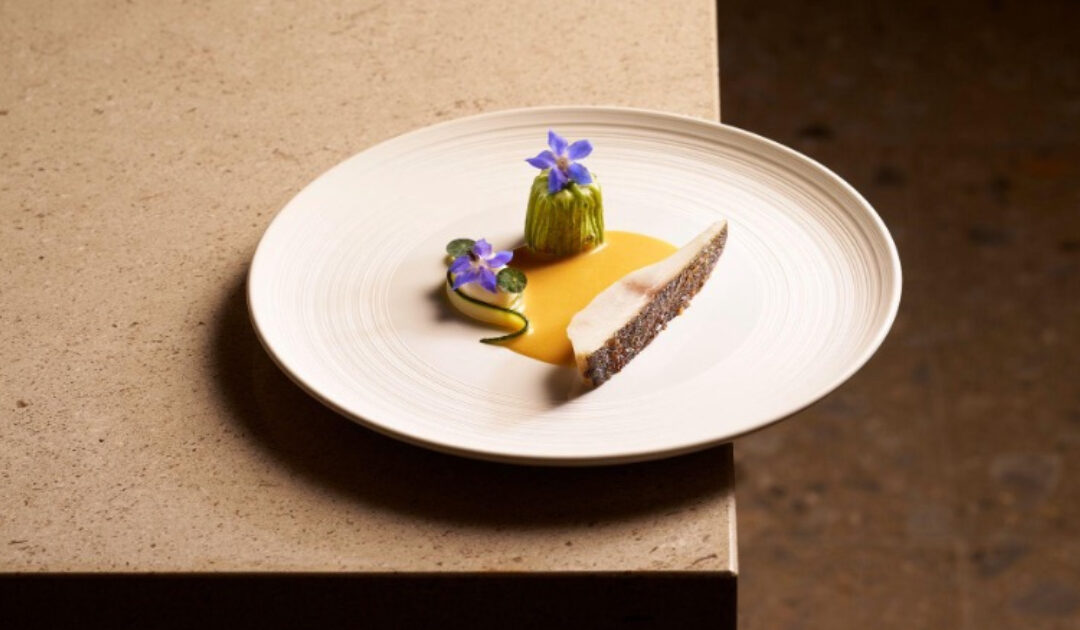
We work from the same premise as others in the category but weigh it differently, giving Southeast Asian produce a genuine role instead of a decorative one. The Japanese calendar sets our sequence, and French methods decide how each course is built. The Nyonya beurre blanc on our Isaki and the Southeast Asian shichimi in the Hassun are two places where weighting becomes visible.
Chef Shusuke Kubota’s training across Japanese and French kitchens is what makes that weighting possible without the menu losing its centre. He is explicit that the Japanese element leads and the French element gives it shape.
The category is wide enough to hold several honest answers. The useful question for a diner is which one a given kitchen has chosen, and that should be legible from the food.
Judging It at the Table
Categories get argued on the page and settled at the table. Loca Niru sits inside the House of Tan Yeok Nee, where an evening in a TIME-recognised heritage landmark starts shaping itself before the first plate arrives. Book a table and see where the two traditions meet.